The map hasn’t changed. Now what?
Median income. Third grade reading. Health insurance. If you've seen any of our presentations over the past decade, you know the punchline is always the same: every map of metro Atlanta looks the same. Over time, the geography of advantage — and disadvantage — barely moves.
At some point, we have to stop admiring the problem* and be much more intentional and proactive about driving regional change, especially if we’re going to take on economic mobility..
🪜 Economic mobility isn't just one problem. It's a set of compounding issues — access to basic needs, social capital, thriving neighborhoods, quality education, rewarding work, and wealth-building pathways – that are experienced by families in different ways. Economic pain doesn’t care about our sector siloes, so we have to learn to work as a more cohesive system.
🤝 Regional change requires collective action. No single entity or sector can do it alone. Metro Atlanta hasn’t had the best track record mobilizing across sectors and communities to tackle a priority issue. We haven’t often agreed on what those priorities even are. Given our regional economic mobility crisis, this is the moment to understand the barriers and pathways to inform more potent regional action. Regional.
⚗️ And the solutions aren't simply programmatic adjustments. Solutions that strengthen our fragile sector will take many forms: stacking existing solutions where they’re needed most, leveraging non-traditional funding models, policy change, and new operating paradigms. We need to creatively leverage our existing assets.
Explore This Resource

Just Communities Protocol: Altadena Case Study 2025
“Altadena’s Not For Sale”.
Dena’s Just Futures sought to credential that existing “lived expertise” and put it within global standards of excellence, so that community leaders would have confidence in their ability to push back against commercial interests who would define the future of the town’s recovery for them.
Explore This Resource

Guide to Developing Resiliency Hubs
This Guide developed by the Urban Sustainability Directors Network is intended to help communities develop new Resilience Hub projects. Most Resilience Hub projects are likely to start by leveraging existing community assets. Some may start with a well- trusted and well-utilized site already identified, while others may start with a strong coalition of community partners. Not all Resilience Hubs will develop in the same order or on the same timeline. Whether starting from designing a community center retrofit, a resilient power solar plus storage installation, or a new emergency shelter, this guide can help identify opportunities to expand beyond a singular goal and meet a wide range of community needs with one project.
Explore This Resource

Englewood Agro-Eco District Village Plaza Plan
A foundational, community-led plan to develop the Englewood Village Plaza, a vacant lot that remained dormant for over three decades, into a new addition to the growing public spaces across the Englewood neighborhood of Chicago. The project is lead by Grow Greater Englewood and serves as the future entry point for the 1.75-mile Englewood Nature Trail, which will be the focal point of the nation’s first Agro-Eco District.
Explore This Resource

Industrial EcoDistricts Primer
This paper presents the Center for Neighborhood Technology's research on a range of innovations for Industrial EcoDistricts in the areas of energy, water, transportation, and waste.
Explore This Resource
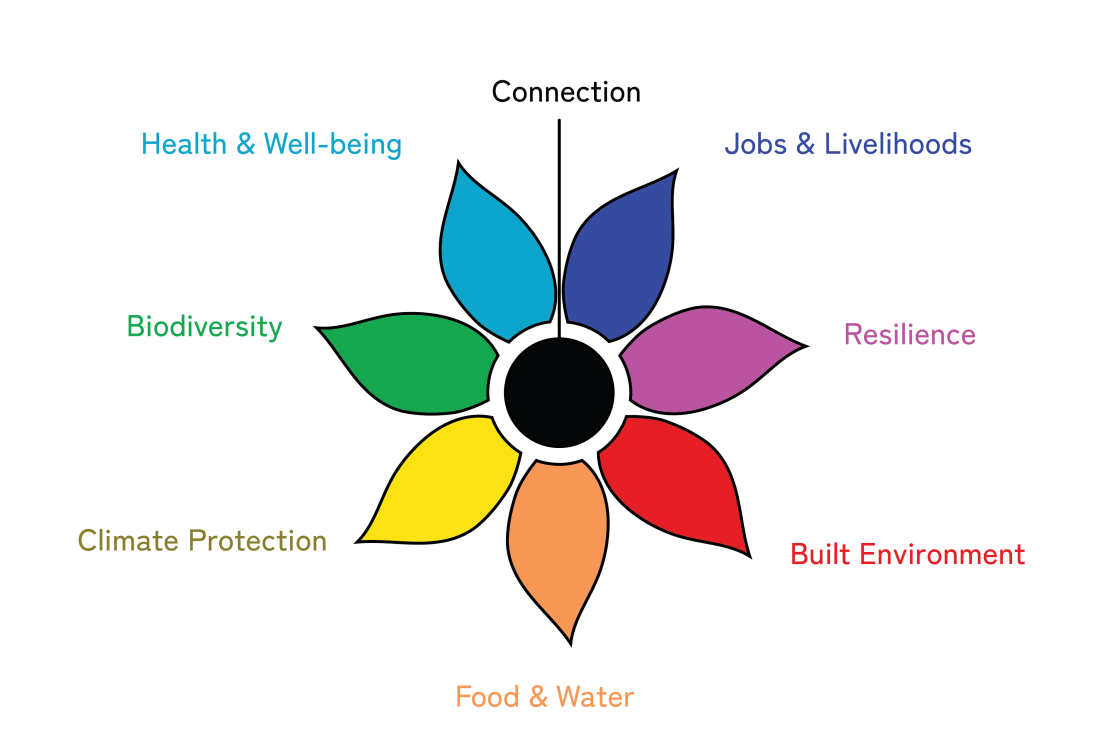
Multisolving Institute Flower Tool
Facilitating Long-term, Whole-system, Equity-based Reflection (FLOWER) is Multisolving Institute’s interactive online community engagement tool to help stakeholders foster the conversations and imagination required to improve strategies, achieve multiple goals, and explore shared needs while prioritizing equity.
The Multisolving Institute is a global movement addressing complex societal issues through integrated solutions. By focusing on climate change, equity, health, and biodiversity, the institute promotes collaborative ways to solve multiple problems with single investments2. They offer resources, tools, and training to help individuals and organizations implement multisolving strategies.
Explore This Resource

The Sustainable Square Mile
The "Sustainable Square Mile Handbook" by Blacks in Green (BIG) and the Natural Resources Defense Council (NRDC) is a guide to creating sustainable, environmentally friendly urban communities. It presents eight principles of green-village building, focusing on community-based practices, economic sustainability, and environmental stewardship.
Explore This Resource

What is a Racial Equity Impact Assessment, Chicago United for Equity
The Chicago Department of Housing's "Racial Equity Impact Assessment on the Qualified Allocation Plan (QAP)" evaluates how Low-Income Housing Tax Credits are distributed and their impact on racial and ethnic communities. The report aims to ensure equitable access to affordable housing for communities of color and working-class families.
Explore This Resource
Racial Equity Impact Assessment Toolkit, Race Forward
The "Racial Justice Impact Assessment" is a comprehensive guide developed by Race Forward to help organizations and policymakers evaluate the potential racial equity impacts of their proposals, initiatives, and policies. It provides practical tools and frameworks to ensure that racial justice is a key consideration in decision-making processes.
Explore This Resource